
The Psychoacoustic Loom
Weaving Frequency, Noise, and Narrative into the Fabric of Consciousness

The Psychoacoustic Loom is a generative audio engine designed to engineer states of mind. It weaves brainwave entrainment patterns into a cohesive auditory fabric of colored noise, voice-based guidance, and near-subaudible affirmations.
The Non-Semantic Layer: Signal & Frequency
At its core, the Loom leverages the physics of sound to influence neural activity. The human brain generates rhythmic electrical pulses (brainwaves) that correlate with distinct states of consciousness—ranging from the deep sleep of Delta waves to the high-level processing of Gamma.
Research1 suggests that exposing the brain to waveforms matching these frequencies can elicit the associated mental state, a phenomenon known as “brainwave entrainment.” For instance, a 40Hz tone can help shift the brain toward a Gamma state associated with focus and binding.
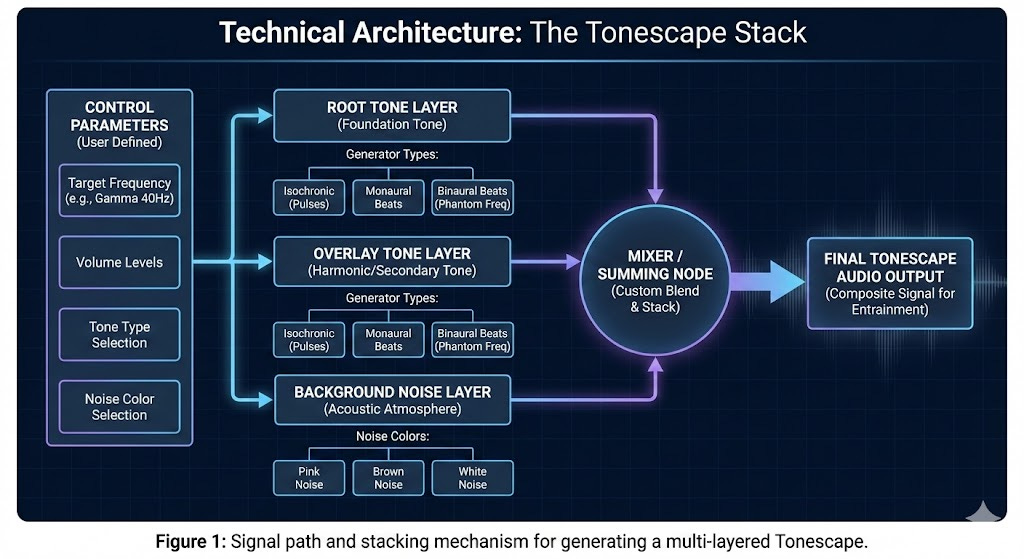
The Loom achieves this using Tonescapes—custom stacks of audio effects that include:
Entrainment Tones: A blend of isochronic tones (time-fixed pulses) and binaural/monaural beats (phantom frequencies generated by the brain to resolve auditory dissonance).
Colored Noise: Audible static used to mask environmental distractions and shape the acoustic atmosphere. While research is ongoing, specific “colors” (spectral densities) like Pink noise (similar to rain) and Brown noise (similar to the ocean) show promise in area like sleep quality, managing tinnitus and stress reduction.
The Semantic Layer: Narrative & Priming
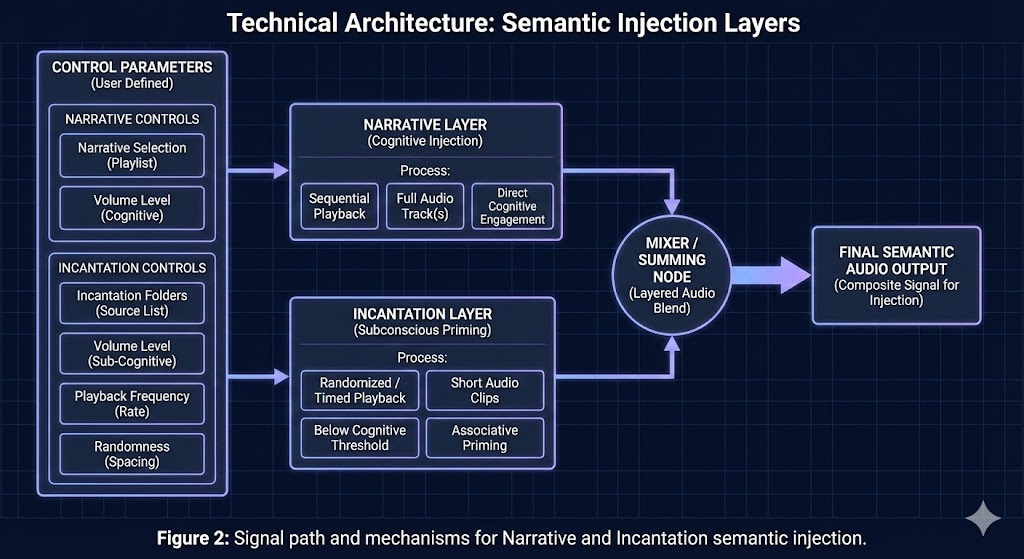
While the non-semantic layer manages the state of the nervous system, the semantic layer directs its content.
Audio Narratives: Guided visualization acts as a top-down induction tool. By engaging the listener’s imagination and predictive processing, a coherent story reduces cognitive noise and coordinates the default-mode and salience networks. This shifts emotional valence and self-perception, allowing the user’s own nervous system to complete the transition into a meditative or trance-like state.
Incantations: These are “associative primers”—short words or phrases mixed just below the cognitive threshold. While they cannot override deep-seated beliefs, strong evidence suggests that near-subaudible stimuli can bias decision-making and affective preference when aligned with an existing need or goal.
Closing the Loop
By combining these layers, the system can achieve interesting and useful effects, such as entraining the brain to a relaxed Alpha state using tones, while simultaneously reinforcing that state with subconscious affirmations.
Currently, the Psychoacoustic Loom serves as the auditory engine for my broader work on “Resonant Environments.” While lighting controls are already integrated, the next evolution is the addition of a contactless bio-sensor platform. This will allow the environment to read the user’s physiology in real-time, creating a closed feedback loop where the room adapts automatically to drive (or be driven by) the user’s mind and body toward their desired state.